Animal mourning and loyalty
The FriendAnimal mourning and loyalty is presented as a bond with real emotional force and as a mystery that human observers cannot fully resolve. Through accounts of dogs waiting for dead owners and the unsettled behavior of Apollo after his former owner dies, the book questions whether loyalty is evidence of understanding, instinct, or something beyond human explanation. Its attention to animal grief also reflects the narrator’s own mourning: the dead remain present in memory, while the living wait, suffer, and try to care for one another.
Grief after a death
A woman describes how her dog responded when his owner died. He waited by the door day and night, stopped eating for a time, and made a low, strange sound that she struggled to name. Treats did not distract him; once he growled at her, and his nighttime keening kept her awake. Seeing him waiting or hearing him cry brought her own grief back with force. She eventually placed him in a kennel because she could no longer bear to have him in the house, though she feared that giving him away or taking him to a pound would betray her husband’s beloved dog. The kennel was expensive, and she did not believe the dog could return home and be happy there.
The narrator’s response is not to dismiss the woman’s distress, but to set the dog’s behavior beside a familiar account of loyalty. Hachikō, an Akita, went to Tokyo’s Shibuya Station each day to meet the train that had brought his master home from work. After the man died suddenly, Hachikō continued to wait at the usual hour for nearly ten years. People could not explain death to him; they made a legend of his waiting and erected a statue in his honor. The story’s public commemoration gives a lasting form to a devotion that could not be explained to the dog himself.
Other examples complicate the idea that Hachikō’s story is unique. Fido, from a town near Florence, waited fourteen years at the bus stop where his master had returned from work before being killed in an air raid during the Second World War. Greyfriars Bobby, a Skye terrier, spent every night of the last fourteen years of his life at the grave of his master, who died in Edinburgh in 1858. People have tended to remember such behavior as extreme loyalty rather than stupidity or mental defect. The narrator doubts a report from China about a dog said to have drowned itself from bereavement, but recognizes that stories of dogs’ fidelity are among the reasons for a longstanding preference for cats.
Apollo’s dislocation
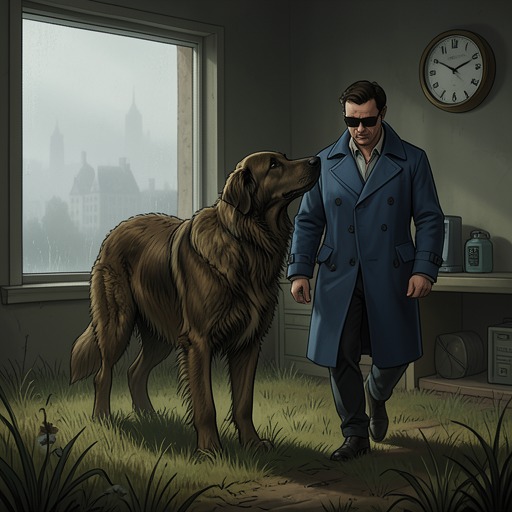
Apollo’s grief appears not as a single emblematic vigil but as a continuing struggle with loss and change. The narrator becomes convinced that he understands his former owner is gone for good and that he will never return to the brownstone. He walks with his head lowered, throws himself onto the bed, and sometimes lies stretched out facing the wall. After a week, the narrator feels more like his jailer than his caretaker, a reversal that registers how care can become painful when the animal’s distress cannot be relieved.
A veterinarian accepts that Apollo is mourning his previous owner and that successive changes in his surroundings have worsened his emotional state. The narrator reports episodes in which Apollo looks around in confusion, clamps his tail between his legs, crouches close to the floor, and shakes uncontrollably. The fits last from a few minutes to half an hour. To the narrator, his posture seems to express an expectation that something terrible is about to happen. The veterinarian is wary of medication for canine anxiety and depression: it may take weeks to work, and may not work at all. The account makes Apollo’s distress concrete while leaving its inner meaning partly inaccessible.
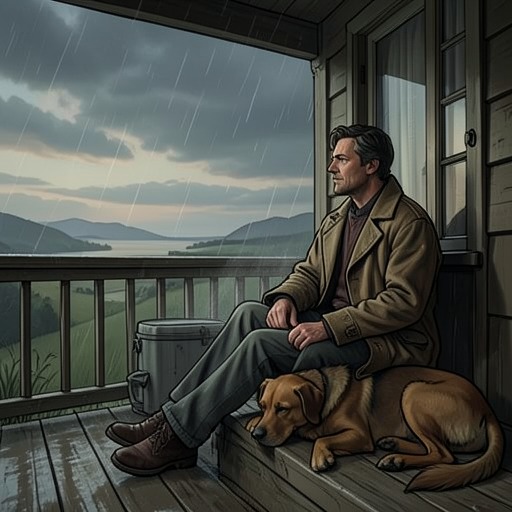
With time, Apollo grows accustomed to his new home and to the narrator. The narrator avoids leaving him alone except when school requires it, and remains anxious to return to him. Apollo greets the narrator at the door, but his welcome appears wistful rather than uncomplicatedly happy; the narrator wonders whether he has waited there the whole time and what enforced solitude might mean to a dog with a strong memory. Even the movement of his tail is described as a subdued wag, unlike the exuberant whipping associated with Great Danes. His new attachment does not erase the earlier one: the narrator wonders whether Apollo is still waiting for his former owner.
The limits of human interpretation
The book repeatedly distinguishes between recognizing animal suffering and claiming to know exactly what it feels like. Dogs and other animals may tolerate pain differently from humans, but their actual capacity for suffering, like the measure of their intelligence, remains mysterious. This uncertainty matters when the narrator considers mastiffs bred to be massive, protective, and loyal. If a master lets such a dog be herded onto a transport truck bound for a slaughterhouse, the narrator wonders whether the dog understands betrayal. The speculation turns instead toward the dog’s possible concern for who will protect its master. The question exposes the human temptation to translate animal experience into familiar moral language, even as the animal’s perspective remains unavailable.
The narrator also insists that animals can be emotionally broken. They may not commit suicide or weep as humans do, but they can lose their minds and have their hearts broken. An account of a cat passed between households after its owner could no longer keep it makes the cost of repeated disruption stark: after two or three moves, one more left the cat a creature no one would live with, and its original owner had it put down. The episode broadens the concern beyond canine fidelity. Attachment and environmental change can matter profoundly to animals, even when humans cannot translate that consequence into a complete account of their inner lives.
Human mourning and the conditional
The narrator’s reflections on Apollo unfold alongside grief for a deceased friend. The book describes the dead as dwelling in the conditional: in thoughts of what would have happened, and in the haunting sense that the absent person might know what the narrator thinks or writes. This form of address preserves intimacy without pretending that death has been explained. The narrator repeatedly acknowledges missing the friend, and the feeling persists rather than resolving into a tidy lesson about acceptance.
That parallel gives animal mourning more than an illustrative role. Apollo’s waiting and the narrator’s continuing address to the friend are different experiences, not proof that a dog grieves exactly as a person does. Yet both make absence present through recurring attachment: a dog at the door, a person returning in memory, a name that cannot be spoken. Near the end, the narrator wants to call the friend’s name but finds that the word dies in the throat, then cries out to the friend. The ending leaves the bond active and unfinished. In this account, loyalty is not a solution to death; it is one of the forms in which love continues to be felt after explanation fails.